
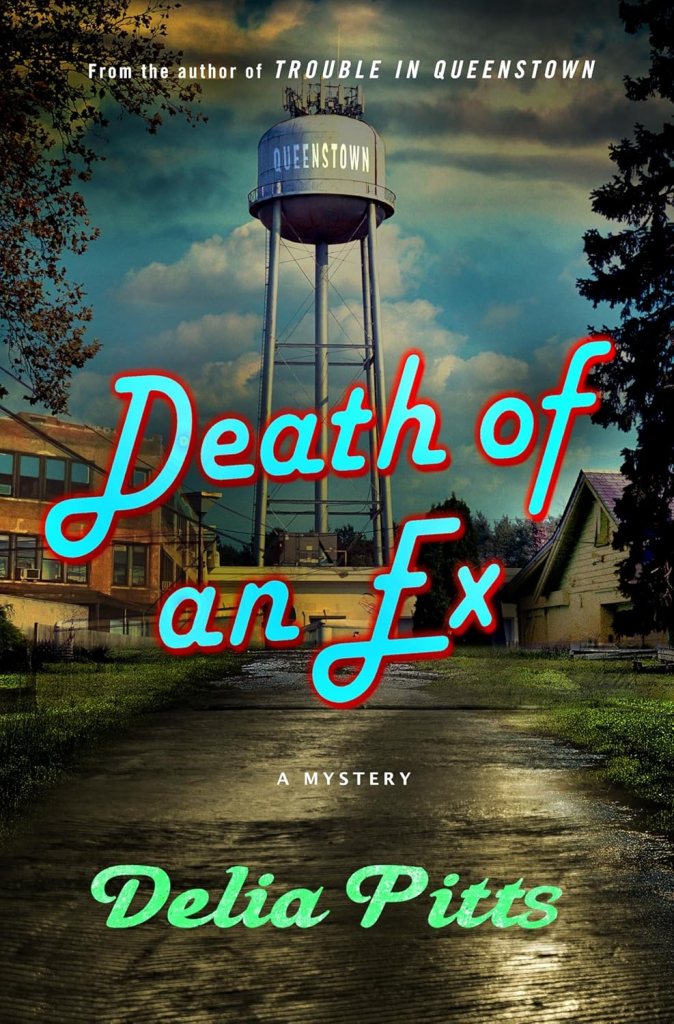
The Chicks are thrilled to have Delia Pitts as our guest Chick today. The Library Journal touts Death of an Ex as “a literary, absorbing whodunit encompassing murder, human compassion, and grief.” It was just released this month from Macmillan books. Below Delia gives us the author’s scoop of “dropping the body” — a key moment of any whodunit. Take it away, Delia.
Where Do I Drop the Body?
The great dilemma faced by bad guys and crime writers alike: where do I drop the body?
You will be happy to learn I have no advice for people in the former category. I’m here to discuss the quandary we writers of crime fiction face as we outline our mysteries. Readers who browse the crime shelves of their favorite online or brick-and-mortar booksellers expect to encounter a death (or several) in the novels they choose. The question we face as writers is how early in our books do we start the slaughter?
There are arguments for several tactics: Go early and go strong. Or drop the corpse later for maximum suspense.
Writers who favor the “short porch” method feel their books are strengthened when a suspicious death takes place early in the narrative. These hot-to-trot scribes prefer to kill in the first or second chapters. Sometimes the victim may even be dead before the story begins.
Police procedurals, of course, require a murder take place before law enforcement is called in to investigate the crime. The novel tracks official efforts to discover the motives underlying the first killing and to prevent follow-up mayhem. Readers track each step of the police work, dazzled by the application of sophisticated technical analysis or expert psychological profiling or down-and-dirty gumshoe digging. For me this kind of novel resembles a ride-along exercise, where I can enjoy an inside look at the dogged pursuit of justice led by an experienced professional. If the cop is jaded, even compromised, so much the better.
Dropping the body early is often found in cozier mysteries too. In these, the amateur sleuth is suddenly thrown into an unforeseen tragedy in an otherwise idyllic setting. I rub my (mental) hands with glee when the opening chapter finds a dead body at a restaurant, library, PTA meeting, bookstore, knitting shop, bed-and-breakfast cottage, or festival.
This homicide is such a desecration of the tranquil setting that the action following the discovery unfolds seamlessly. I relish discovering how the amateur investigator will apply an arsenal of specialized knowledge and crafty skills to exonerate the innocent friend. The less familiar I am with the professional talent or hobby of the sleuth, the more I enjoy the case.
Thrillers often take a different approach to the question of when to drop the body. Excruciating delay can be the author’s best tool. The enjoyment for me comes from anticipating when the worst will happen. The danger will be articulated early in the story, but the arrival of a dead body may not occur until near the middle of the novel, when the threat is actualized and a victim is claimed. The first of many, we fear. Now we – and the main characters – know the danger is mortal. The proof is in the death. Our rising anxiety for the remainder of the thriller is tied to the main character’s frantic efforts to avert a larger catastrophe.
This delayed approach to when to drop the body may also be found in many domestic or romantic suspense novels. In these books, the first crime may not be a murder, but another serious violation such as stalking, harassment, bullying, extortion, or psychological abuse. Escalation to homicide in the story’s second act twists the knife and ratchets the suspense.
For my own Vandy Myrick mysteries, I often devote the early sections to building entanglements. Sometimes, I won’t drop the body until several chapters in. First, I like to explore – and then jerk– the bonds which tie the eventual murder victim to an array of figures, including the main character, small town private investigator Vandy Myrick. For me, as both a reader and a writer, I want to know lots about the victim. What he wants, who he torments, who he fears, who he loves. If I don’t know those things, then I won’t care if he lives or dies. And that goes double for Vandy. If she knows the victim, cares deeply about the death, and is tangled in the motives for the crime, then my engagement is ironclad.

Bio: Born and raised in Chicago, Delia graduated from Oberlin College with a Bachelor’s degree in history. After working as a journalist, she earned a Ph.D. in African history from the University of Chicago. She is a former university administrator and U.S. diplomat. Her contemporary noir mystery, Trouble in Queenstown, was published by Minotaur Books in 2024. It is a finalist for the Shamus award of the Private Eye Writers of America. The second book in her Vandy Myrick mystery series, Death of An Ex, was published July 15, 2025. Delia is also the author of the Ross Agency Mysteries, a series set in Harlem. She has published several acclaimed short stories, including, “The Killer,” which was selected for inclusion in Best American Mystery and Suspense 2021. Delia is an active member of Sisters in Crime, Mystery Writers of America, and Crime Writers of Color. Delia and her husband live in central New Jersey and have twin sons living in Texas. To learn more about Delia and her books visit her website, deliapitts.com or contact her on instagram @deliapitts50 or on bluesky @deliapitts50.
Authors: Do you favor a quick approach to dropping the body? Or do you prefer to delay the murder(s) until well into your book? Readers: Which technique fires your engine? Do you want to find the body in the first chapter? Or would you rather wait for the suspense to simmer before the killer strikes?
 Chicks on the Case
I prefer the body drop to be early in the book, but I’ve read books where it was much later because you knew it was coming.
LikeLiked by 3 people
Yes, Dru, knowing the death is coming is more than half the fun!
LikeLike
Thanks, Delia, for an excellent overview of body drops. I prefer whatever hooks readers at the start and keeps them turning pages. This puts the spotlight on what “target” readers prefer. Typically, writers adopt and adapt whatever feeds their writer passions while going beyond the target readers’ expectations with twists that surprise and delight. Thus, for a series, we see early drops, later drops, stretched-out drops, and more. Such fun using all the variations.
LikeLiked by 4 people
Grant, I agree. As a reader and as a writer, I love all the variations.
LikeLiked by 1 person
Thank you, Grant! The variations are what keeps us writing – and reading!
LikeLiked by 2 people
Delia, what a fantastic post! Thank you so much for visiting with us today and exploring the many and varied ways of dropping those bodies. I don’t have a preferred method. As long as at least one body drops, I’m good. Congratulations on Death of an Ex! I can’t wait to read it
LikeLiked by 2 people
Thank you, Patricia! One body minimum for sure!
LikeLike
Welcome, Delia! I’ve done it both ways. It all depends on what the story needs.
LikeLiked by 3 people
Thanks, Liz! You are so right about discerning the needs of the story!
LikeLiked by 2 people
Great explanation of the choices and reasons behind them, I do like a bit of variety, probably why I read several crime genres. In most mysteries I like the body to drop fairly soon. In a thriller, it can come a bit later, helping to build the suspense.
LikeLiked by 3 people
Reading several genres is a good idea! I need to get around more myself!
LikeLike
I guess I don’t have a preference. I never pay attention to when the body drops. I once saw someone in a chat forum ask if she should continue a book because she had read more than 50 pages and there was no body yet. I figure it is the author’s story to tell. I know that when I am reading a mystery, there will be a body sooner or later.
LikeLiked by 2 people
You have confidence in the author, which is golden music to us!
LikeLiked by 2 people
Agree!
LikeLike
What great timing for this blog post, Delia, because I’m right now trying to figure out the plot of my next Orchid Isle mystery, and when to drop the body is on the top of my list of questions. I hadn’t thought too much about how waiting a bit allows the reader (and sleuth) to get to know the victim, and how that might affect the story–so thanks!
Congrats on “Death of an Ex,” and thanks so much for visiting the Chicks today!
LikeLiked by 3 people
Thank you, Leslie! These questions of pacing and craft are always so interesting to me!
LikeLike
Thanks for being here, Delia! Congrats on Death of an Ex! And thank you for the thorough list of subgenres and murderous timing.
As a reader, I’m happy to read all kinds of body drops. As a writer, I tend to go early, probably because I’m solidly in the cozy space.
LikeLiked by 2 people
Thank you, Jen, for inviting me! I’m trying to learn from you to drop my bodies earlier!
LikeLiked by 1 person
Ha! Maybe I should prolong the suspense?
LikeLiked by 1 person
I’m an end-of-first-chapter body dropper, myself… although once I waited all the way until the second chapter! (LOL) But when I’m reading, I love both approaches!
LikeLiked by 3 people
Marla, I bet your readers love the early body drop approach too!
LikeLike
Love the restraint, Marla! 🙂
LikeLike
I’m like you, Delia. I establish my victim and his relationships before I drop a body. I like to do it in real time rather than people only talking about him or her in the past tense. I like establishing tension and attitudes re: the victim. Which means I usually don’t drop the body until around page 50.
LikeLiked by 3 people
Ellen, I’m trying (at my editor’s request) to drag that body closer to the opening chapters! We’ll see how that goes, LOL!
LikeLiked by 1 person
That’s a very precise number, El!
LikeLiked by 1 person
Perfectly put!
LOL! It’s page 47 in my current WIP. It’s been as high as 60. But I make sure there’s a build of tension. Sandra Murphy encapsulates it really well in her comment below.
LikeLiked by 1 person
Thank you so much for visiting us today, Delia! What a great post…I especially love this description: “The danger will be articulated early in the story, but the arrival of a dead body may not occur until near the middle of the novel, when the threat is actualized and a victim is claimed.” So wonderful how this strategy creates tension for readers, as we know something is coming but not exactly when.
As a writer, so far, I have leaned toward the first chapter (or at least by the end of chapter three, as I was once advised), but as a reader, as long as something interesting is happening until the body drops, I’m in. 🙂
Congratulations on your book (gorgeous cover too). I’m looking forward to reading it.
LikeLiked by 2 people
Cynthia, thank you for your lovely comment! I’m trying hard with every book to make the murder happen earlier and earlier!
LikeLiked by 2 people
Thank you so much, Chicks, for having me back on the blog! I had loads of fun thinking about this fraught topic!
LikeLiked by 3 people
Thank YOU, Delia, for sharing this lovely post with us!
LikeLiked by 2 people
Delia, what a great post! That “sooner-the-body-the-better” rule (for cozies, at least) has been proclaimed by agents, editors and panel authors at just about every writers’ craft conference I’ve ever been to. I try to reveal the murder by the end of the third chapter, but sometimes I wish we could see the murderee in action a bit more–positively or negtively–before they turn up deceased. (Worked for Agatha Christie!) Plus, when the murder beat is always in the same place, it takes out some of the suspense in my book.
LikeLiked by 1 person
Delia, I love the way you’ve put so much thought into perfect timing for a body drop. In my experience deal often leads to complaint from editors and readers!
LikeLiked by 1 person
When the book starts with the main character (who we like or will) arguing in a public setting with another character (who no one likes), I can count on the body to be discovered in the first chapter or at least by the start of chapter two. Now the character we like is in jeopardy – will the police think she’s the killer? It gives her a reason to investigate – to save herself. In the next books in the series, it’s a friend or relative who is on the hot spot and she helps. Thrillers depend on suspense. Readers need to feel the anxiety and resist the urge to look over their shoulder as they turn the pages. Whichever timing works best, just don’t let it drag on too long. We need time to mourn (or rejoice) the victim.
LikeLiked by 2 people
I love them either way, as long as there are suspense, mysteries and unextwists that keep me glued to my seat! – Emily
LikeLike