
Lisa here, delighted to welcome Chicks’ friend and distinguished author Thomas A. Burns, Jr. (Tom to us!) to the blog today. Sherlock Holmes fans, you’re in for a treat as Tom introduces his latest Holmes pastiche, SHERLOCK HOLMES IS. . .THE WIZARD OF MONTAGUE STREET, and shines a lantern on the mysteries of the Great Detective’s early days.
Greetings to the Chicks and their followers, and a big thank you to Lisa for the invitation to do a guest post. I’m Thomas A. Burns, Jr. (as Tom Sawyer said to Becky Thatcher, that’s the name they lick me by, I’m Tom when I’m good). I write three series: The Natalie McMasters Mysteries, contemporary thrillers; The Tales of the 3M Detective Agency, traditional P.I. stories set in the 1990s; and Sherlock Holmes pastiches in the tradition of the original stories by Sir Arthur Conan Doyle, known by Sherlockians as the Canon. It’s this series I want to tell you about today.
I came to Sherlock Holmes as a boy, through a Classics Illustrated comic book featuring Doyle’s story The Adventure of the Speckled Band. It had everything I wanted as a kid—a mad doctor, a poisonous snake, exotic wild animals, a damsel in distress, and a brilliant detective who could solve the mystery. I immediately sought out Doyle’s stories and found that I had to read them with a dictionary at my elbow, but that was O.K.—I was in love with words even then.
Flash forward to now. I’ve written three volumes of Holmes pastiches, Ten Steps from Baker Street, A Peek into Watson’s Dispatch Box, and my most recent endeavor, Sherlock Holmes Is… The Wizard of Montague Street, the book I want to focus on in this post.
Sherlockian chronologists place Holmes’s arrival in London around 1877 when he took rooms in Montague Street, “just round the corner from the British Museum”. While Doyle gave us a couple of stories about the Great Detective prior to his residence in Baker Street (i.e., The Musgrave Ritual and The Gloria Scott), he told us almost nothing about Holmes’s early days in London before Watson, or exactly how he perfected some of the unique methods he used in later investigations.
In Doyle’s first Holmes story, A Study in Scarlet, we meet the Baker Street division of the detective police force, aka the Baker Street Irregulars; a gang of street urchins whom Holmes sometimes employs as his eyes and ears. They “…go everywhere, and hear everything. They are as sharp as needles, too; all they want is organisation.” Their leader is a teenage boy called Wiggins. Again, Doyle provides little information as to how Holmes came to be associated with people so far removed from his own social class. This is one question I explore in Wizard.
In the first story, we meet twenty-three-year-old Sherlock coming up to London from University, with four gold sovereigns in his pocket and a burning desire to take up a profession the world has not yet seen—consulting detective. He rents a loft at number 24 Montague Street from the enterprising Mr. Potts for five shillings a week. At that rate he’ll have three months or so to start earning a living, or he’ll have to go back home to mother and admit defeat. His plan is to scour The Illustrated Police News for open cases he might lend his skills to solving, but he finds most of these have already been cleared. More importantly, though, he encounters a gang of street urchins who style themselves The Montague Mews Boys, who sleep in the disused stables behind his loft. He gives them a dazzling show of prestidigitation with coins and other objects, which earns him the sobriquet “The Wizard”.
The group varies in size as boys come and go, but some of the more important members are:
Alf – Sixteen, he is the unofficial leader of the Boys. Thrust into adulthood before his time, Alf rises early and sleeps lightly; he keeps track of who enters and leaves Montague Street without appearing to pay attention. He insists the younger boys stay clean, eat when possible, and travel in pairs after dark. He listens more than he speaks and remembers faces with near-photographic clarity. When Holmes gives instructions, Alf carries them out precisely, but he also improvises intelligently when circumstances change. He does not steal from the poor—a rule he enforces strictly among the boys—but he’ll pinch a purse from a toff in an instant.
Jonty – Fifteen; he is Alf’s second-in-command and proud of it. He’s methodical, remembering faces, shoes, clothes, carriage insignias, and the sound of footsteps on different cobbles. He can follow a man across half of London without being noticed and knows when to hand off a tail. He keeps careful mental tallies of time and distance and reports concisely. On the downside, he has a temper. He’s fiercely loyal to Alf and protective of the younger boys, especially Mouse.
Cal – Thirteen, he’s Alf’s alternative lieutenant when Jonty’s absent. He’s good-looking and somewhat fastidious; he seems to want to prove he’s not just another street boy. He doesn’t steal for sport, only when necessary for survival or if Holmes needs him to. Once given responsibility, he guards it fiercely, and he thinks for himself, which is sometimes not for the best. Holmes challenges him to become literate, so he enrolls at a Ragged School even though he’s older than most of his classmates.
Wiggins – In 1877, the future leader of the Baker Street Irregulars is one of the youngest of the Montague Mews Boys at nine. He serves mainly as a messenger and a lookout, but desperately wants to be more. He lives from moment to moment and steals as a matter of course. He’s intensely curious and headstrong, not necessarily a good combination.
Dickie, aka Richard Thackery – Also nine, he’s the son of Lord Aldington, a resident of the neighborhood. Dickie gives the boys spare change and food so they’ll allow him to hang around. Wiggins has adopted him as a charge. When the two of them go missing, Holmes gets his first (unpaid) case in London.
Mouse – His age indeterminate, he appears even younger than Wiggins. He’s Jonty’s brother in all but blood and he’s a mudlark, the lowest of the low, making his living from scrounging in the muck of the Thames at low tide for anything he can sell for a few pennies. When his body is found one misty morning, Holmes is launched into his next case.
Subsequent adventures take Holmes and the boys to Covent Garden, London’s great produce market, a music hall in Hoxton and the docks of the Thames, among others. They interact with rich and poor alike, from the prosperous streets of Mayfair to the squalid rookeries of London’s East End.
Doyle’s depiction of Victorian London in the Canon is somewhat romanticized, likely because a depiction of its harsher realities probably wouldn’t have sat well with the magazine editors who bought his stories. In the interest of historical realism, as well as an engine to drive the plots of some stories, I chose not to overlook them. For example, human corpses which no one had the desire or the funds to bury became commodities, giving rise to the grim profession of body dealing, i.e., taking them from the streets and selling them to medical schools, anatomists and others who might need them. Street crime was rampant in the rookeries, and the poor were often exploited, including enforced servitude, illegal prize fights, employment as smugglers, and in other illicit activities. Surrounded by such inequities, a man of Holmes’s character could not help but become infused with the moral sense and desire for justice which later became his most renowned characteristic.
During his investigations, Holmes becomes aware of an overarching malevolent force, one that seems to have a hand in every misery the boys encounter, from the theft of medical supplies from hospitals to the child prize-fight promoters. The man behind the force has a name, and he becomes the young detective’s first archenemy. This scoundrel does indeed help mold Holmes into the Great Detective who later resides in Baker Street.
Writing these stories has been a real joy, partly because it has allowed me to answer questions that have nagged me since I first read that Classics Illustrated comic book and the rest of the Canon. How did Holmes win the trust of a gang of street urchins? What did they teach him in return? I suspect the answer is more than Holmes would ever admit to Watson.
ABOUT THE BOOK:
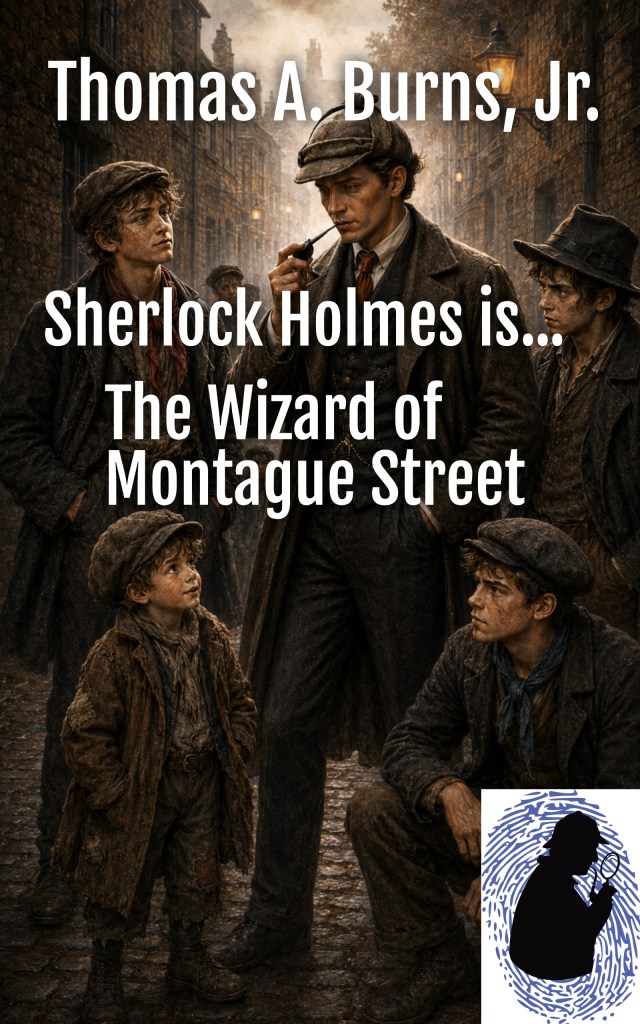
Thomas A. Burns, Jr. has published two acclaimed collections of Sherlock Holmes pastiches in the style of Sir Arthur Conan Doyle, chronicling previously unknown exploits of the Great Detective from his arrival in London in 1877 to his retirement to the Sussex Downs during the Great War. Now there is a third volume, devoted entirely to Holmes’s time without Watson on Montague Street, just around the corner from the British Museum, aided by his able allies, the Montague Mews Boys.
Roam the streets of London with Holmes and the boys as they take on new cases in the sprawling market at Covent Garden, the Little Italy of Saffron Hill, and the elegant neighbourhoods of Mayfair and Belgravia. Accompany them on investigations involving London’s Ragged Schools, the venerable Britannia Theatre in Hoxton, and against smugglers on the River Thames. Watch as Holmes discovers a malevolent force behind many of the city’s most heinous crimes, and struggles to bring down his first archenemy. From fog-shrouded alleys and gaslit theatres to posh gentlemen’s clubs, schoolrooms both mean and scholarly, bustling wharves, and rat-filled rookeries, this volume depicts the young Holmes as his methods are honed, his reputation begins to grow, and his moral code is forged. Before Baker Street, before the world knew his name, Sherlock Holmes had already begun his war against London’s hidden wickedness, with a band of ragged boys at his side and danger waiting in every shadow.
This is Sherlock Holmes as you’ve never seen him before: young, brilliant, untested, and unmistakably the Wizard of Montague Street.
Sherlock Holmes Is…The Wizard of Montague Street is available now at https://www.amazon.com/Sherlock-Holmes-Wizard-Montague-Street/dp/B0H8VDKCSQ . You can find more about all three of Tom’s series on his website: https://www.3mdetectiveagency.com/ .
ABOUT THE AUTHOR:

THOMAS A. BURNS, JR., author of the Natalie McMasters Mysteries and an active status member of the Mystery Writers of America, writes from Wendell, North Carolina, where he lives with his wife Terri, his two adult sons Séamus and Taidhgin, six cats, and a Vizsla named Vixen. He has begun a new series featuring Amos Murdoch and the 3M Detective Agency with To Keep Our Honor Clean, followed by The Pilgrim. The 6th book of the Natalie McMasters Mysteries, Killers!, won the Silver Falchion award for best action/adventure book of 2021 at the Killer Nashville International Writers’ Conference and the 7th book, Sister!, was a finalist for the same award in 2023. To Keep Our Honor Clean was a Judges’ Top Pick (i.e., semi-finalist) in 2025 and The Pilgrim was a finalist in 2026. Tom’s Holmes story, The Camberwell Poisoner, appeared in the March–June issue of The Strand Magazine in 2021, and MX Books and Belanger Books have published many others. Tom independently published his first volume of Sherlock Holmes stories, Sherlock Holmes and Dr. Watson: Ten Steps from Baker Street, in 2023, followed by A Peek into Watson’s Dispatch Box in 2024, and Sherlock Holmes Is… The Wizard of Montague Street in 2026. Tom has also written a Lovecraftian horror novel, The Legacy of the Unborn, under the pen name of Silas K. Henderson—a sequel to H.P. Lovecraft’s At the Mountains of Madness.
Tom would love to hear from you on his social media pages:
| https://www.facebook.com/groups/541595279667727 | |
| TikTok | https://www.tiktok.com/@nataliemcmasters |
| https://www.instagram.com/3mdetective | |
| X | https://x.com/3Mdetective |
Now, a question for the Chicks’ readers. What drew you to Doyle’s stories about Holmes and Watson? What’s your fave Sherlock Holmes story, and why? Tell me in the comments. And many thanks again to Lisa and all the Chicks for having me today.

