As some of you know, my boyfriend is a Brit. Ian is a delight, and I’m crazy about him. There is a problem, however.
The language barrier.
As many in Britannia are wont to do, Ian speaks UK English, a.k.a. English English. Or as I like to say, English2.
Sure, we understand each other most of the time. As a Python-quoting, Austin-reading, English lit-majoring Anglophile, I know my way around a lift, bonnet, torch, and trainers. I also fare better than dear Alexa in deciphering an accent with R’s added to words that end in vowels. (Exhibit A: The Beatles’ “Lovely Rita[r]”.)
The trouble is in the spelling.
UK English favors–or should I say favours–what I feel are superfluous U’s. Then there are S’s subbing in for Z’s (or rather zed’s), C’s posing as S’s, -tre suffixes on words like “centre” and “theatre” (which feels vaguely French), and (for me) the brain-frying double vowels oe and ae in words like “foetus” and “anaemia.”
The grammatical differences don’t end there. UK English-speakers consider collective nouns, like a band or a family, as plural rather than singular, and treat subject-verb agreement as such. “His family were marvelous.” “The band are coming to America.” They also use single quotation marks where we would double-up. Past tense gets fancy with “spelt,” “learnt” and “et,” instead of “spelled,” “learned,” and “ate.”
And don’t get me started on aluminium.
Lately, I’ve been finding myself adopting Britishisms. I used S rather than Z when writing “analyze” as “analyse” the other day. Then I said, “That’s what Cecilia was on about” when relaying a story.
Blimey.
So far, no mentions of adjusting my “schhhhedule” or parking in the “GAR-age.” But perhaps that’s next when I ask Ian about getting his mates together for a night out with the lads.
There’s a great book by Bill Bryson called The Mother Tongue about the origin of English in its many forms, and interestingly my dad bought me this book before he knew I was dating Ian.
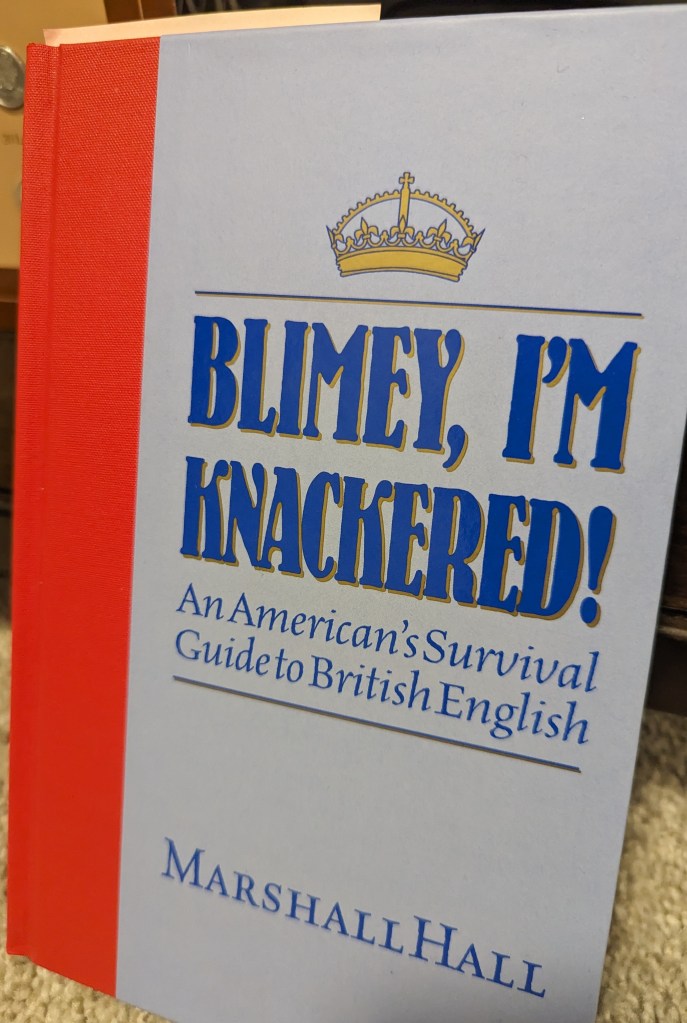
So far, it’s come in handy. Love may be the international language. But it’s nice to know what a butty is.
Dear readers, do you use UK or US English in your daily writing–or something else? Do you fancy a British-accented voice for your car’s navigation? Do you have a funny UK vs. US English misunderstanding to share? I’d be chuffed to bits to know.
 Chicks on the Case
How can you use the word butty and not tell us what it is?! This is smashing, Kathy. I’m a bit jelly you’re dating a Brit. I always wanted to. BTW, I doubt “jelly” doubles as a Brit expression. But I feel like if it doesn’t, it should.
LikeLiked by 3 people
Ha! I agree!! “Jelly” sounds totally Bri’ish.
LikeLike
Oh PS! A “butty” is basically a sandwich on a bun/roll. Terminology largely depends on region: https://www.express.co.uk/life-style/food/516026/British-regional-names-for-rolls
LikeLiked by 1 person
As a writer, I’m schizo. My Natalie McMasters Mysteries are written in a patois of Gen Z slang, but I also write traditional Sherlock Holmes stories in Victorian English. I just finished one about the death of a former French polisher. And funny you should mention the car’s nav system. Trudy has an Irish brogue.
LikeLiked by 2 people
Love that, Tom! Very eclectic. And I didn’t realize the brogue was an option!
LikeLiked by 2 people
I encounter this mostly in my day job, when we have to localize our writing for Canada, England, Australia, etc. We have an automatic variable to do it for us.
LikeLiked by 2 people
I’d love to know more about this, Liz! I recently had to localize for Canada, and I did it manually, which I’m sure isn’t the best idea!
LikeLiked by 1 person
We have a variable that we insert in words that use either “s” or “z.” When we publish our documentation, we select the value that should be used. The value is based on country, so if you pick US, it uses “z.” If you pick “Canada,” it uses “s.”
LikeLike
I’m married to an Englishman, had a mother from Georgia, an Italian-American father from Pennsylvania, and we live in Virginia. Imagine the confusing terminology in our household.
LikeLiked by 4 people
You’ve got a United Nations there, Grace! I’d love to listen in on a conversation!
LikeLike
I just returned from a visit to England where I spent a few days with my British half-sister in Winchcombe. She taught me how to say “gasping for a cuppa” and by the time I left, she was saying “sure, you guys.”
LikeLiked by 2 people
lol! Love it, Keenan! The mutability of accent and idiom is so interesting. I have a friend from Petaluma who married an Aussie, and she now has the strongest Australian accent I’ve heard!
LikeLiked by 1 person
We have a generation of young kids, who are speaking with a slight British accent from watching so much Pippa Pig shows.
LikeLiked by 3 people
Oh goshhhhhh, my kids loved Peppa!
LikeLike
I just melt at a British accent. It is so romantic sounding.
In my writing, I tend to use British spelling for many of the words where there’s a slight difference. Grey, not gray! And yes, I always throw in the u. For some unknown reason.
As far as talking goes, I am definitely a cross between PA speak and the southern belle.
And fyi, the British speak English. Plain and simple. Here in the States we speak American.
LikeLiked by 2 people
I’m pro-grey, too!! And I love the PA/belle combo. (Liberty Belle?!)
LikeLiked by 1 person
Too funny, Kathleen. On a six-month assignment in the UK, I leaned on my British partners to translate. I’m still amazed at how our common language can impede mutual understanding.
LikeLiked by 3 people
It IS amazing! I guess the two are cousins, not sibs–maybe even cousins-once -removed!
LikeLiked by 1 person
The differences between the English & American languages always intrigued me, I used to have a discussion about this in my HS English classes. My favorite misunderstanding was when my son was in daycare and the Irish carer scolded me for not putting him in a vest. Who is she, the fashion police? Then I found out she was referring to an undershirt!
LikeLiked by 2 people
Ha! I didn’t know about vests = undershirts. I would have been flummoxed!
LikeLiked by 1 person
Of course I know that vest is waistcoat (pronounced weskit), I just didn’t know that vest had its own meaning!
LikeLiked by 1 person
Ahhhhhh I didn’t know about waistcoat, either! Then there’s the whole jumper thing…
LikeLiked by 1 person
I know! I’m a knitter & have to remember that I have American & British patterns with different terms!
LikeLiked by 1 person
O:be found I tend to use “sat nav,” “car park,” and “takeaway,” that ks to all the Irish and British TV I watch.
When I watch Premier League Football, the use of the singular when talking about teams continues to throw me off. Cheers!
LikeLiked by 2 people
What gets me is when I can’t remember which is the American word and which is the English word—especially takeaway vs carry out.
LikeLiked by 2 people
Then we have regional US differences to add to the mix! Love the variety.
LikeLike
Or the combo: takeout!
LikeLike
Takeaway! Love that one. Seems so friendly and fun.
LikeLiked by 1 person
One of my friends uses a British voice on her gps/sat nav – I asked if it said car park instead of parking lot & she said it hadn’t come up 😉
LikeLiked by 1 person
ha! Great question!
LikeLike
When my family lived in England when I was a teenager, I remember my dad cutting out a headline from the newspaper about the World Cup team that he thought it was funny: “England are Slipping.”
I’ve long been partial to “grey” over “gray,” and still cross my 7s and zeds as a result of that year abroad. But I could never bring myself to say “leff-tenant.”
LikeLiked by 3 people
“Leff-tenant” is a puzzler, for sure! I cross my sevens and Zs, but didn’t realize that was an English thing! I think I was encouraged to do so in an effort to make my terrible penmanship more understandable.
LikeLiked by 1 person
The crossing 7s and Zs is a European/Latin American thing–probably elsewhere, too. And here’s to terrible penmanship!
LikeLiked by 2 people
I continually promise to reform–then don’t!
LikeLike
I cross my 7s sometimes but not my Zs–what does that make me?
LikeLiked by 1 person
Keeping your options open!
LikeLike
I’m Team USA when writing (though I do prefer “grey”). When I’ve had to judge international contests, the UK spelling/grammar does throw me off.
On the other hand, I did purchase a British phrase book once as research for a character (in a currently shelved manuscript).
And my dad grew up in Malaysia, which had British rule. He once told me a story about being in the US and asking to go to the lavatory–and how teachers were wondering why wanting to visit the science building seemed so urgent!
LikeLiked by 2 people
That is hilarious, Jen!! Yesssss, the lav. Also the very direct “toilet” versus our euphemized “restroom.”
LikeLike
How much fun is this post? Thanks for the laughs, Kathy! I need that book. I do a triple take whenever I see “cosy” mystery. I have Irish family and “yer man” and “yer wan” always get me. (Huh? What man? What one?) I also learned quickly not to be a “wagon” and what a “hen party” was—a bachelorette, not a Chicks conference party!
LikeLiked by 1 person
Wagon?!! I don’t know that one!
LikeLike
I use American. Some of the English spellings do make me do a double take since I’m used to the American spelling.
LikeLiked by 1 person
Same, Mark! The example given of “cosy” is a good one for me!
LikeLike
Love this: “I know my way around a lift, bonnet, torch, and trainers.” 😀
LikeLiked by 1 person
There are so many I don’t know–but I’m learning!
LikeLike
I really only follow Gordon Ramsay, and his favorite word connects equally in US English. LOL!
LikeLiked by 1 person
lol! It’s well known on both sides of the pond!
LikeLike
I’ve mostly picked up British phrases from British mysteries and detective shows, so mostly standard fare. But hubs and I have enjoyed Sarah Milligan comedy specials. Her humor leans to the bawdy, so I’ve learned some naughty words and phrases we weren’t previously acquainted with!
LikeLiked by 1 person
I just started watching her, Vickie! HILARIOUS!!
I was also just talking about how I often need the subtitles on for some shows based in the British Isles. Any Gavin and Stacy fans out there (from the way back machine)?
LikeLike
I got into an interesting discussion on ‘maths’ and ‘math’ with me Southampton mate. He was ganging up on me with his college daughter. Their point was maths is short for mathematics. So, I suggested that maths implies plural, as if Pythagorean math impregnated chaos math and had multiple little baby maths. And then maybe it should be ‘mathi’ or ‘mathen’ rather than ‘maths’. They were both nonplused with my argument. Or, perhaps, in the UK that would be said ‘non-multiplied’. For me, to this day their logic in support of ‘maths’ just does add up. But my mate and I don’t let this matter be divisive, we are still mates for the remainder.
LikeLike
Sometimes when my buddy is in the states I have to play a bit of the interpreter. When he says he ‘has to check his diary’, I tell the confused clerk ‘calendar’. We still argue over ‘maths’. That is just illogical. And he tells me I will never say ‘Worcestershire’ correctly no hard I try. So I compromise and just call it Lee and Perrins and we are both satisfied. It is a give and take exercise.
LikeLike