There’s a meme going around Facebook these days showing a sign in a bookstore that says “Shoplifters will be forced to read James Joyce’s Ulysses.”
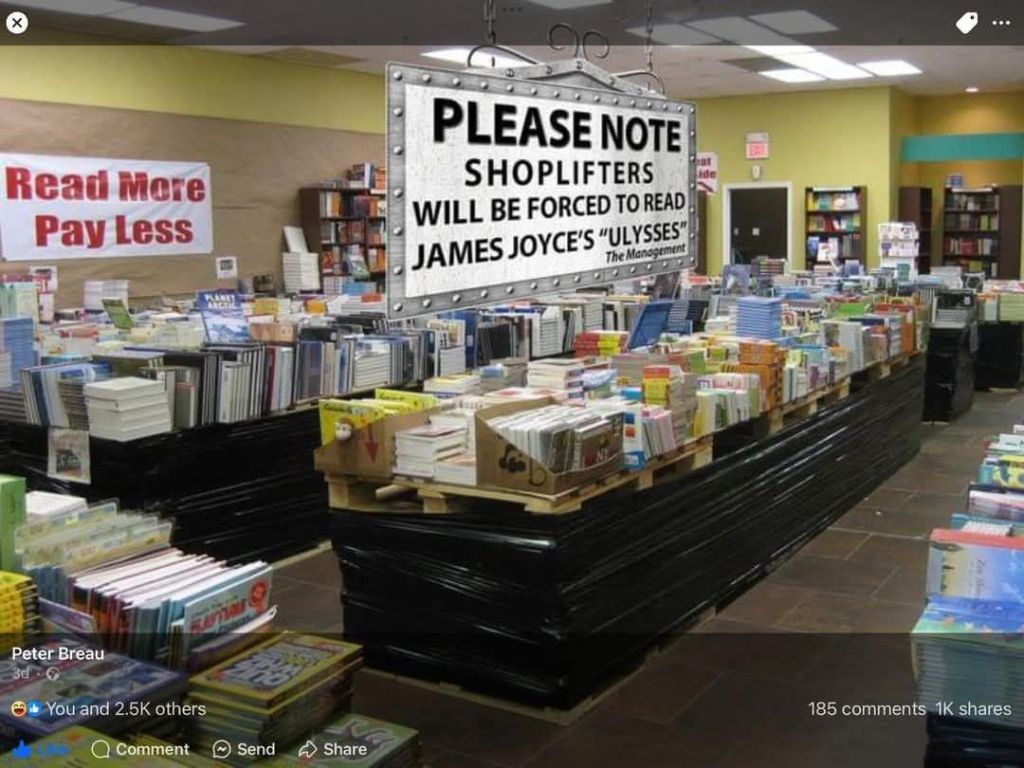
I get the joke; really, I do. (Even Louise Penny shared the meme on her FB feed.) But I think bookstores, of all places, should know better.
Because, the thing is, I adore Ulysses and think it’s one of the best books ever written. And I love all of James Joyce’s other work, too. Yes, even Finnegans Wake.
I’ve never been much one to join bookclubs (though I’m always ready to appear at them as an author!). But I’ve been a member of one particular book group for almost seventeen years now. And we’ve only read one full book, as well as fifty pages of another, during that time.
Those books are Finnegans Wake, which we’ve now read together twice through, and Ulysses, which we just started two months back, deciding it was time for something “easy” for a change.
The bookclub started out partly as simply a way for a group of college friends to have an excuse to get together, drink Guinness, and talk about the book—as well as everything in life. Because this work of fiction—I hesitate to call it a novel—by James Joyce tells the story of, well… everything (borrowing heavily from Italian philosopher Vico’s conception of the cycles of civilization).
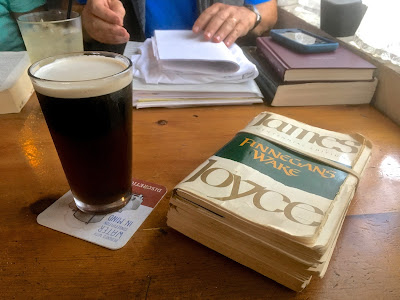
Finnegans Wake (that’s not a typo—there’s no apostrophe; think of it as a subject and verb) may well be the most difficult English language book there is, as it’s full of made-up portmanteau words and foreign language puns, and is written in a dense, stream-of-consciousness style. But if you can wade through the prose, it’s wonderfully rewarding: insightful, beautiful, and at times laugh-out-loud funny. (For a peek at the prose, click here.)
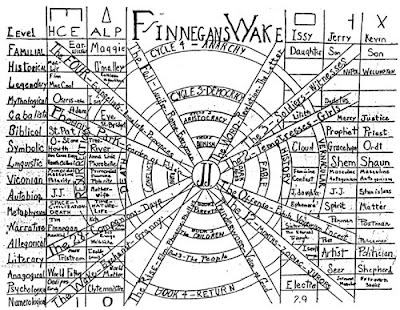
visual representation of Finnegans Wake by László Moholy-Nagy
It’s helpful to read what others have said about the work, and so we bring along satchels full of literary criticism, concordances, and annotations, which we continually consult as we read the pages aloud to each other.
But now we’ve moved on to Ulysses, a work very loosely based on Homer’s Odyssey. Yes, it’s difficult, too (though far less dense than Finnegans Wake), and I recommend reading it with other people—with a book group, or a class, or at least with skeleton guides to help you along on the journey. (There’s also a terrific podcast about Ulysses called Re Joyce, in which the delightful author and scholar Frank Delaney takes you, paragraph by paragraph, through the work. But be forewarned that he tragically died after getting through only a quarter of the book.)
But what the general public doesn’t realize about Ulysses is how full it is of humanity and humor. Here’s what Salman Rushdie had to say about the book:
Everyone said that it was such a sealed book, hard to penetrate, but I did not think so at all. You never hear people say that there is so much humor in the book, that the characters are so lively or that the theme—Stephen Daedalus in search of his lost father and Bloom looking for his lost child—is so moving. People talk about the cleverness of Ulysses and about the literary innovation. To me it was moving, in the first place.
And Joyce’s power of description, his ability to make the reader see, hear, and feel the scene, is unmatched by any writer I know of. Here’s a passage from what we read in our group last week, describing a pair of people on the Sandymount Strand in Dublin with their dog:
Cocklepickers. They waded a little way in the water and, stopping, soused their bags, and, lifting them again, waded out. The dog yelped running to them, reared up and pawed them, dropping on all fours, again reared up at them with mute bearish fawning. Unheeded he kept them as they came towards the drier sand, a rag of wolf’s tongue redpanting from his jaws.
I dare you to write a better description of a dog running about on a beach.
So, sure, we can all laugh at how difficult James Joyce is to read. (And he did, after all, famously say of Ulysses, “I’ve put in so many enigmas and puzzles that it will keep the professors busy for centuries arguing over what I meant, and that is the only way of insuring one’s immortality.”)
But if you have the desire, time, force of will, and staying power to read Ulysses, I can assure you that it’s well worth the effort.
So perhaps you should shoplift, in order to be gifted with this marvelous work of art.
Readers: Have you ever read any James Joyce? Or other so-called “difficult” writers? What did you think?
 Chicks on the Case
Leslie, thank you for writing such a persuasive argument for reading James Joyce’s work. I haven’t read Ulysses but now I’m excited to.
LikeLiked by 3 people
It’s definitely worth dipping into, Patricia, even if you don’t read the whole thing.
LikeLiked by 1 person
Leslie, such an insightful post! I took a course in college that focused on Joyce. I’m with you on Ulysses–and as with Finnegans Wake, I just relax and enjoy the imagery, mood, and language. (Plus: Ireland.) We started with Portrait of the Artist as a Young Man, which I loved. I think maybe Portrait prepared me for Joyce’s other works. And how can you beat the opening line starting: “Once upon a time and a very good time it was there was a moocow coming down along the road…” I’ve never forgotten it!
LikeLiked by 3 people
PS My mom (English teacher/librarian) always hated Moby Dick.
LikeLiked by 2 people
I’ve only ever read the beginning of Moby Dick.
LikeLiked by 2 people
Me, too, Jen! (My mom gave me a lifetime pass on that one, ha.)
LikeLiked by 2 people
😂
LikeLiked by 1 person
Ha! I must admit I’ve never even tried it.
LikeLiked by 3 people
I’ve tried, and failed, three times to read Moby Dick. I’m done.
LikeLike
Yes, Portrait is definitely a great way to start with Joyce–or his book of short stories. And his description of childhood in the beginning of Portrait is a masterclass in writing–so vivid you feel like you actually see him as a young boy!
LikeLiked by 3 people
Wow, am I impressed. Reading you describe your group, I feel like a philistine! My only contact with James Joyces was an experimental theatre class in college where for an entire semester, we did nothing but various and weird takes on the first page of Finnegans Wake. Not gonna lie, it totally turned me off Joyce until now, when you’ve made Ulysses sound intriguing. (Sidebar: that acting instructor was let go after one year. The “wake” turned out to be his career as a theatre prof at Tulane!)
LikeLiked by 4 people
Yeah, starting with the Wake is a really bad idea, lol. I do love that first page, but not for an entire semester!
LikeLiked by 3 people
Kudos to your book club, Leslie! I’ve only read bits of Ulysses–and specifically for purposes of enhancing my writing. I really should wade back into classics, but I have so many modern books in my to-read pile!
LikeLiked by 3 people
I know! I was just thinking yesterday that I’d love to re-read some of my favorite books from when I was a lit student, but I have all these mysteries to read!
LikeLiked by 3 people
I feel like I’ve read one Joyce story in high school, but just a short story.
Here’s the thing, I read to have fun and relax. Anything that requires that much work to enjoy doesn’t sound enjoyable to me.
LikeLiked by 3 people
I get it, Mark–it’s a completely different kind of reading!
LikeLiked by 2 people
As an English major, I’ve read most – if not all – of the “difficult” writers. While I wasn’t a huge Joyce fan, he was better than some.
LikeLiked by 3 people
For me, it was Faulkner–could never get into him.
LikeLiked by 3 people
Funny! I kinda liked Faulkner.
LikeLiked by 2 people
Ha! And lots of people do!
LikeLike
I read The Sound & The Fury in college for a class. Yeah, didn’t get it at all.
LikeLike
I think that’s the one I tried. Not my thing.
LikeLike
I’ve never read it, but Tim has. He’s been taking on some ambitious books in the last few years! You make a strong argument, and I feel slightly smarter just for having read your post!
LikeLiked by 2 people
Lol, Marla. You ARE smarter for having read the post. 🙂
LikeLike
I did read it, when I was a freelancer and had a lot of time on my hands. I read it like it was a college course. Read a chapter along with an audiobook version, then listened to a Great Courses dude explain WTF happened in the chapter, then read the again to say “okay, I get it.” It was a fun project and I think I liked the professor even more than the book!
LikeLiked by 2 people
That’s absolutely the way to read Ulysses, as well as the Wake. And it’s even better with a group of friends!
LikeLike
Probably the most difficult read I’ve ever finished was The Three Musketeers. Took a looong time, but it was worth it!
LikeLiked by 1 person
I’ve never read it, but maybe I should…
LikeLike
How wonderful! Thank you, Leslie. I wish I could have joined your club.
This makes me miss graduate school, where we read difficult literature and loved to talk about it–often carrying it outside the classroom into social gatherings…there were times where we literally argued all night about the meaning of something or other.
There was a serious Joyce scholar in my department at my current job when I first arrived. Pretty much everyone agreed that he was one of the smartest people around. Have to be, to be a Joyce scholar!
LikeLike