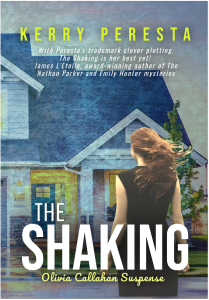
We’re so happy to be hosting Kerry Peresta, author of the Olivia Callahan Suspense and Back Before Dawn. Please help us give her a warm welcome!
When a Character is Cornered, the Claws Come Out
 Suspense is often mistaken for momentum (short chapters, ticking clocks, escalating perils), but none of that matters if the character at the center remains unchanged. In my own work, I didn’t fully understand this until I realized every story I admired lingered not because of the danger, but because of who the protagonist is forced to become in order to survive it. The unanswered question isn’t what happened or who did it, but what will this person sacrifice, confront, or finally admit when the truth makes escape impossible?
For years, I approached suspense as a structural problem. If the plot sagged, I tightened the timeline. If tension lagged, I added an unforeseen risk. The stories were competent, but lacked an essential element. I felt I hadn’t done my best. But a pesky deadline loomed, and I had to wrap it up sometime!
 I concluded suspense isn’t sustained by danger alone, it’s sustained by resistance. Tension. Pressure. The most compelling suspense protagonists aren’t racing toward answers, they’re running amok. (I love to cause my protagonist to run amok and at book club talks my character’s erratic behavior inspires the most lively conversations!) Readers may shake their heads at the protagonist’s blindness, feel pulses quicken as they argue with the protagonist, warn them which path ends in destruction, or beg them to walk away from a toxic relationship. That fleeting sense of reader superiority is part of the contract, one the author should dismantle in the next chapter, catching the reader off guard. The mystery in suspense exists not just because information is hidden, but because the character has a moral or ethical reason not to uncover it too quickly, or at all. In upmarket suspense, the external inciting incident often mirrors an internal one: a buried grief, a moral failure, a truth about self which may be the bigger threat.
 Once I began writing with this in mind, I cut wide swaths through ambitious descriptions or irrelevant backstory. Interrogations became less about extracting facts and more about exposing internal conflict. Additional information didn’t just advance the plot, it had to destabilize the carefully constructed identity the character relied on to function. The question driving each chapter shifted from what happens next to how much longer can this person remain stuck in an intolerable situation due to their unwise choices?
I don’t know about you, but in my complicated and disaster-ridden past, I made many unwise choices which provide great launching pads for a plot. Lemons into lemonade!
Perhaps this is where the traditional mystery genre and the suspense genre part ways. The clues matter, but instead of the primary task of uncovering the perpetrator of a crime, the clues in suspense seek to remove the protagonist’s exit ramps. There is space for ambiguity, for psychological complexity, for moments where the most unsettling outcome isn’t death or exposure, but self-recognition. With each revelation, the protagonist’s ability to remain unchanged in the midst of chaos narrows. When the story works, the reader senses the mystery drawing to a close, but the issue of the protagonist’s growth and change is a separate issue. By the final chapters of the story, the reader should feel a sense of contentment (or outrage) that the mystery has been untangled, and also a deep, lingering empathy for the protagonist and a great sigh of relief at the turning of the final page. The mystery within the story has done its work. It has cornered the protagonist into transformation.

After decades of crafting punchy headlines and persuasive campaigns, Kerry Peresta traded the advertising world for full-time writing and the salty air of Hilton Head Island, SC. Kerry is the author of Olivia Callahan Suspense, a five-book series; and standalone thriller Back Before Dawn, all released by Level Best Books. Her humor column, “The Lighter Side,” appeared weekly in the Pierre Daily Journal from 2009-11; and her articles, stories, and interviews have graced the pages of Local Life Magazine, Lady Lowcountry Magazine, Island Events Magazine, and Bluffton Breeze. Her short story, “The Day the Migraine Died,” was selected for Rock, Roll & Ruin, an anthology by Triangle Sisters in Crime, 2022, and she and three other female mystery writers created the mystery podcast “Guns, Knives & Lipstick.” Her latest, unpublished manuscript was selected as a Top Pick in the 2025 Claymore Awards. Kerry is a member of Sisters in Crime, International Thriller Writers, Mystery Writers of America, South Carolina Writers Association, and Island Writers Network. Discover more at kerryperesta.com.
 Chicks on the Case
Everything comes from character.
LikeLiked by 3 people
Totally agree! Suspense leans a bit more into character, I feel, which I love! ❤️
LikeLike
Yes! And good to see you here, Tom!
LikeLiked by 1 person
Kerry, it’s so nice to “meet” you–and welcome to Chicks today! Such an intriguing post–I was particularly struck by your idea of playing with a reader’s sense of superiority from chapter to chapter. I guess that goes for every mystery genre!
LikeLike
Sorry, I’m not sure how my comment moved!
LikeLike
Hi Lisa, Thanks for commenting! Is t that the truth? Readers love to figure out what happens next and I enjoy trying to figure out how NOT to tip them off!! Hard sometimes. 🤔😎
LikeLike
Welcome, Kerry. Character development and change is key to any great story.
LikeLiked by 3 people
Agree! Some books lean more into the mystery/riddle and I love the ones that feature character development a bit more. Which usually leads me to devour suspense novels! Hope you are well! I miss our podcast. 🥲📚
LikeLiked by 2 people
Welcome, Kerry! Thank you so much for visiting with us today. Great post! I love character arcs. I love reading/watching how the characters develop.
LikeLiked by 2 people
Me, too! Think Girl in the Train, The Housemaid, The Silent Patient…I love these types of stories. ❤️❤️❤️
LikeLiked by 1 person
Thanks for guesting, Kerry. I love your emphasis on character driving the plot rather than vice versa. Wise words!
LikeLiked by 2 people
Thanks Ellen. I’m always looking for an interesting, flawed character who gropes her way through life. I think all readers relate to this experience. 😂
LikeLike
Thanks for being here, Kerry! I love the concept and imagery of protagonists running amok!
LikeLiked by 1 person
Yes OMG nothing better than a character running amok. Thx for commenting. 🥰
LikeLiked by 1 person
Great article and discussion!
Authors interviewed for the NYT Book Review “By the Book” section are often asked what’s more important, plot or character. Nine times out of ten, they say character. But I think I may fall on the plot side of the equation, at least when I’m reading a mystery. Thinking of Miss Marple and Hercules Poirot: they’re certainly “characters,” (as in, “she’s such a character!”), but they have no arc; they are the same character on page one through to The End. In those mysteries, plot is everything. I’m working on a series of cozy mysteries and am much more worried about plot than character right now. (But, I’ll soon see what the editor thinks!).
LikeLiked by 2 people
Great points, Robin! I of course love Miss Marple and Poirot and Jessica Fletcher and Nancy Drew and all the other classic sleuths whose actual selves remain somewhat shadowy. I’m excited, though, that the cozy world has creatively expanded so much in recent years in terms of both characters’ personalities and story arcs/underlying subplots. I guess now we authors just need to keep focusing on both characters and plots that continue to grow, all in the pursuit of justice!
LikeLiked by 2 people
Absolutely and that is the difference between cozy mystery or traditional mystery…they demand plot, or as I call it, the riddle. Suspense is more about overcoming obstacles and flawed characters trudging through, and we may already know who the bad guy is. It’s the why that becomes more important.
LikeLiked by 1 person
All the best with your series, Robin!
LikeLike
Thanks, Jennifer!
LikeLike
Hi, Kerry, fellow former copywriter here! Good food for thought. Thanks for stopping by today!
LikeLike
Thanks so much for commenting! It is always a joy to be in these blogs. I appreciate the opportunity! ❤️
LikeLike
This post came at a great time for me, Kerry, as I’m now struggling with the messy middle of my WIP. Great ideas to wrestle with, so thank you!
LikeLiked by 1 person
Aww that is great!! Sometimes just a tiny change of perspective is all we need to fire up those engines again. All the best wishes for your WIP! ❤️📚
LikeLike
Aww that is great!! Sometimes just a tiny change of perspective is all we need to fire up those engines again. All the best wishes for your WIP! ❤️📚
LikeLiked by 1 person
Thank you!
LikeLike
You’ve got this, Leslie!
LikeLike
I’ve found the best books combine a great plot with characters we want to see succeed and who grow as they face something personal. Sounds to me like what you are describing perfectly.
LikeLike
Yes I agree. And I love love love cliffhangers. 😎That’s part of the equation in my stories, for sure.
LikeLike