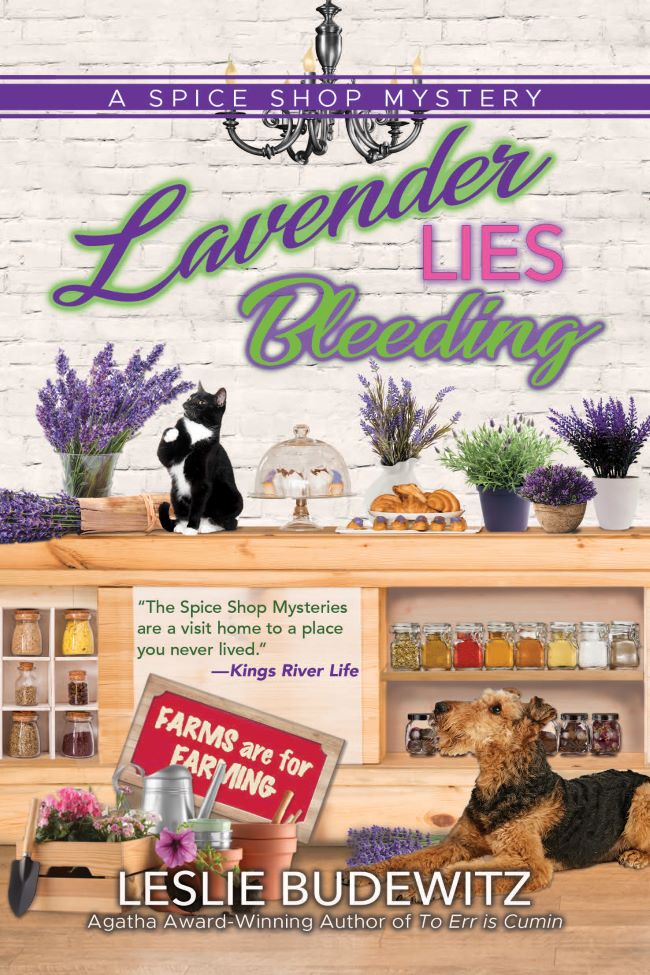
It’s always a special day when our fabulous author friend Leslie Budewitz is our guest here on Chicks. Today Leslie discusses “the other” stuff that makes good stories great–and she’s giving away a signed copy of her Spice Shop mystery LAVENDER LIES BLEEDING to one lucky winner!
There’s more than one way to tell a story . . .
by Leslie Budewitz
There’s more than one way to tell a story.
There’s what happens in the chapters—the people, the places, the plot.
And then there’s all that other stuff.
I love using Other Stuff to add layers to a story and make it even more fun. Stuff like cast lists, maps, chapter epigraphs, and recipes. Chapter titles, glossaries, and footnotes*—more fun tools I haven’t used yet. And of course, historical notes and acknowledgments.
When I was writing Assault & Pepper, the first Spice Shop mystery, I decided to use chapter epigraphs. What better way to share those short snippets of research that relate to the story but don’t fit in the text itself? Spice trivia—everything from the definition of herbs and spices to European wedding customs involving cumin to tips on growing and using lavender, for Lavender Lies Bleeding, the 9th in the series, coming July 15.
An herb is a fresh or dried leaf. A spice is a dried plant part—a bud (cloves), bark (cinnamon), root (ginger), berry (peppercorns), seeds (fennel), or even stigma (saffron). The same plant may provide both—fresh or dried cilantro leaves are the herb cilantro, while the dried seeds are the spice coriander.
— Assault & Pepper, Ch. 1
Lavender is a member of the mint family, along with savory herbs like thyme, rosemary and oregano.
— Lavender Lies Bleeding, Ch. 7
We all like learning new things when we read. I find my future quotes in spice and garden reference books and websites, cookbooks, and even on Jeopardy! (Yes, I ran the spice category on a recent episode.) Plus readers send me their discoveries.
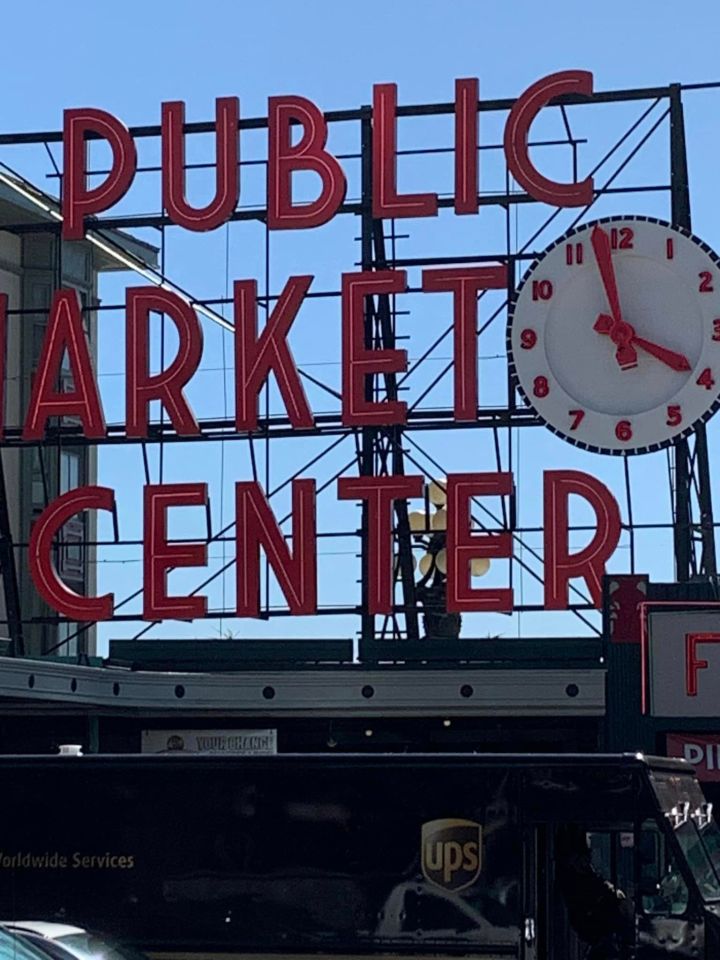
The series is set in Seattle’s Pike Place Market, a place I fell in love with as a college freshman and where Pepper Reece runs a spice shop and solves crime. I’ve got a stack of books on Seattle history, and I often spot useful tidbits in the Seattle Times and the Market newsletters. Each book also takes Pepper and readers to another part of the city. In Between a Wok and a Dead Place, which starts at a Lunar New Year festival, much of the action takes place in the Chinatown–International District. So, many of the epigraphs describe Lunar New Year traditions and food; a series on the origins of the fortune cookie is woven through the chapter headings. Others focus on the history of the neighborhood.
From listening comes wisdom. From speaking comes repentance.
—fortune cookie wisdom
— Between a Wok and a Dead Place, Ch. 14
In Lavender Lies Bleeding, I worked in historical bits about the ramps that once tied the Market to the waterfront, later repurposed to create the Market’s lower levels. All that ties in neatly to the final confrontation—but I’ll let you read the book to discover just how!
The epigraphs can also reflect a theme. Pepper is “a mature, introspective sleuth,” as reviewer and former librarian Lesa Holstine says. Raised in a Catholic peace and justice community, she worked in a law firm before buying the Spice Shop, and is deeply committed to protecting the people around her from injustice. In Assault & Pepper, she finds VHS tapes of the BBC’s Brother Cadfael series in a box her parents left behind when they moved to Costa Rica, along with several books in the series by the late Ellis Peters. Still new at the business of spice, she soaks up wisdom from the old monk and comes to see him as her spirit guide. Naturally, that led me to quote him several times.
“I know my herbs. They have fixed properties, and follow sacred rules. Human creatures do not. And I cannot even wish that they did.”
— Brother Cadfael, in St. Peter’s Fair, by Ellis Peters
— Assault & Pepper, Ch. 28
Sometimes, the epigraphs prompt a surprising response. In Assault & Pepper, a sometimes-homeless man named Sam is suspected of killing a man called Doc on the Spice Shop’s doorstep. Several other street men are witnesses, and Pepper gets to know them and their circumstances. I drew on a song I learned decades ago at Girl Scout camp:
It’s a poor man who can’t see the beauty in the sun and the wind and the rain. And it’s a sad man who can’t love his neighbor and always finds cause to complain. —Traditional American folk song
— Assault & Pepper, Ch. 14
A reader wrote to say she and her sister collect folk songs; what more could I tell her about this one? All I had was the camp songbook I’d created over the years, with the lyrics written in my 12-year-old’s cursive, which I shared with her. She dove into the research and found sheet music, so I didn’t have to sing it and send her a recording, but no historical info other than what I’d told her—that it was often sung at Girl Scout camps. But now she can sing it, too. (As I am, right this minute.)
And finally, because Arf the Airedale, aka Mr. Ambassador, is not just a cute companion and cover model but many readers’ favorite character, after Pepper, I love to sprinkle in dog stuff.
Airedales, the King of Terriers, were the most popular dog breed in the country in the 1920s. Presidents Teddy Roosevelt, Calvin Coolidge, and Warren Harding all owned Airedales; Harding’s pooch attended Cabinet meetings, sitting in his own special chair.
—Chai Another Day, Ch. 13
Lord, make me the person my dog thinks I am. —the dog owner’s prayer
— Lavender Lies Bleeding, Ch. 23
Readers, what fun things have you learned from a mystery or another novel recently? (Do tell us the title and author if you can.)
* And yes, there are novels, including mysteries, using footnotes, but darned if I can come up with examples right now!
***UPDATE: Cherierj, you are Leslie’s lucky winner! We will be in touch with you with info to claim your signed copy of Lavender Lies Bleeding!*** GIVEAWAY: Leslie is generously offering a signed paperback copy of Lavender Lies Bleeding (Seventh St. Books, July 15, in pb, ebook, and audio) to one lucky US commenter. Winner will be announced here on this post and on our Chicks on the Case Facebook page Friday morning.
ABOUT THE AUTHOR:
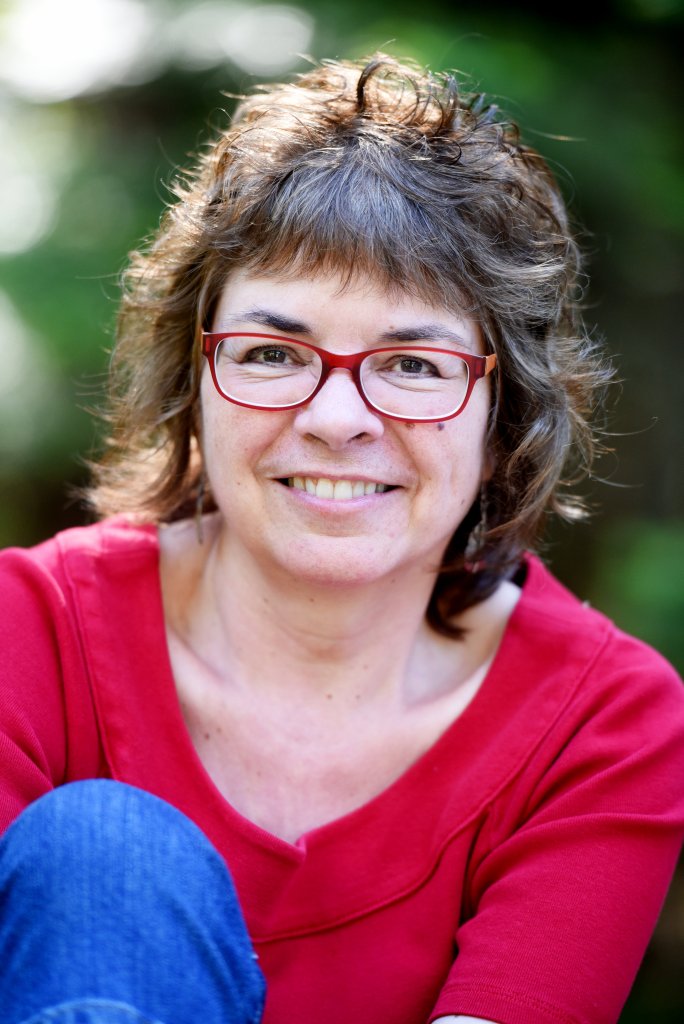
LESLIE BUDEWITZ writes the Spice Shop mysteries set in Seattle’s Pike Place Market, and the Food Lovers’ Village mysteries, set in fictional Jewel Bay, Montana, based on the small town where she lives. As Alicia Beckman, she writes standalone suspense set in Montana and the NW. Her latest books are Lavender Lies Bleeding, the 9th Spice Shop mystery, and All God’s Sparrows and Other Stories: A Stagecoach Mary Fields Collection. A national best-seller and three-time Agatha Award winner, Leslie believes that stories are the spice of life.
ABOUT THE BOOK:
Pepper Reece, owner of the Spice Shop in Seattle’s Pike Place Market, is shocked when vandals destroy the greenhouse at her friend Liz Giacometti’s lavender farm. But then Liz is killed, and Pepper digs in to solve the crimes. As her questions threaten to unearth secrets others desperately want to keep buried, danger creeps closer to her and those she loves. Can Pepper root out the killer, before someone nips her in the bud?
Read excerpts and more, and find buy links, at www.LeslieBudewitz.com
 Chicks on the Case
Thanks, Leslie, for showcasing the fantastic use of cast lists, maps, chapter epigraphs, and recipes to create threads that weave throughout the story. Heading to your site to check out the excerpt and links!
LikeLiked by 3 people
Thanks, Grant! If you spot a good quote for me, send it my way!
LikeLiked by 1 person
I picked one from my database of writing tips and quotes. Here’s Emily Dickinson on the power of this moment: “Forever — is composed of Nows.” (Source: Forever — is composed of Nows (690) from the Poetry Foundation)
LikeLike
The way she said those simple things . . .
LikeLiked by 1 person
That a family secret can be a big mystery that can someone on an unexpected trip.
LikeLiked by 2 people
Family secrets! So bad for families, so good for fiction!
LikeLiked by 1 person
I love being able to learn something while I read, whether about a job, craft, location, recipe, etc. Just recently I’ve learned about war heroes in Boston (A Body in Boston-Terrie Farley Moran), interior design (Lemon Yellow Lies-Emily Oberton), Hawaii (Deadly Trade-Sara Driscoll), cider making (Deadly to the Core-Joyce Tremel), just to name a few. I know authors can put hours of research into something that might only lead to one sentence in a book, and I so appreciate it!
LikeLiked by 2 people
You’re so right about the ratio of research time to words on the page! But we love sharing what we learn with you — and you’ve found some terrific authors!
LikeLike
Good morning and congratulations on the new book! The Spice Shop series is one of my favorites. I’ve now hooked my sister on it as well. I learn something in almost every book I read. Some help me gain insights into people, others offer tidbits of interest worth remembering, and some give me thoughts I don’t really want to retain! I have learned how to organize and prep a clam bake from Barbara Ross, that lava flow has a strong sulfur smell from Leslie Karst in Molten Death, was reminded how much I loved Brother Cadfael (my gateway to cozies back in the day) by you and Pepper and will just skip mentioning anything from that last category because I really do not want to think about them!
I do appreciate all the epigraphs, citations, maps, cast lists. Wish all book covers included book numbers in series and glossaries in books with unusual or foreign words, but I still enjoy the stories, so keep ’em coming! Thanks much!!
LikeLiked by 2 people
Thanks so much! And I’m glad you mentioned getting insights into people through reading. It’s so true — books can show us so much about the world and the people in it.
LikeLike
Leslie, this is so fun to read. I love all those extra “tools”–and especially the camp song story. I have one, too–from a family camp near Cambridge, Wisconsin, attended by mostly people of Norwegian heritage. I included a couple of lines in my forthcoming Kate Hamilton Mystery. Does anyone but me know this song? (must be sung a Norwegian accent):
The cold vind doth blow and ve shall have snow
And vat vill da birdie do den (da poor t’ing)?
He’ll fly to da barn to keep himself varm
And tuck his head under his ving (da poor t’ing).
LikeLiked by 3 people
Connie, I love it! Not a song I learned at camp, though I can come up with silly songs for almost any reason — or none at all. 🙂
LikeLike
And you kept a list of the lyrics! Cool!
LikeLike
Oh, I was quite into singing and playing my guitar back then!
LikeLike
Thanks for being on the blog, Leslie! I really love those chapter epigraphs you use! I’m constantly learning via books, whether fiction or not. Just one example: in Ghosts of Waikīkī by Jennifer K. Morita, I learned a lot about Hawaiian history.
LikeLiked by 1 person
Armchair travel! Thanks, Jen!
LikeLike
Love your Spice Shop Mysteries, dear Leslie!
One of the reasons I love Dorothy L. Sayers’ Lord Peter Wimsey mysteries so much is because the books take us into fascinating subcultures, such as bell-ringing and 1920s London advertising.
As for novels with footnotes, I think “Infinite Jest” has to win, since about a quarter of the book consists of (hilarious) endnotes.
LikeLiked by 1 person
Thank you, my dear! The Lord Peter books are a great example of an author who sneaks interesting info into her books. Along with your examples, I think of life at a women’s college, Russian refugees in England between the wars, and shell shock.
LikeLiked by 1 person
And tides, and fly fishing, and gentlemen’s clubs, and the art scene in London in the 1920s. She was truly amazing.
LikeLiked by 2 people
Leslie, thank you so much for visiting with us today. I loved your post so much. I learned a lot and you stirred all the little gray cells.
LikeLiked by 2 people
Ah, the little gray cells! Thanks, Patricia!
LikeLike
I’ve learned a lot but for some reason, nothing comes to mind except from the book I just finished, The Great Mann, by my friend Kyra Davis Lurie. It’s a reimagining of The Great Gatsby in Los Angeles’ Black community post WWII, and I learned a ton from that about their lives; average citizens, icons, and Black celebrities like Hattie McDaniel and Louise Beavers, who were often reviled in their own community for the servile roles they played, which many felt hurt the Black cause instead of helping it. I always knew the West Adams District had many wonderful and stately homes, but know I know much more about it and the racial covenants that the community fought back against. I’m dying to explore the community now. Although sadly, the community lost when the powers-that-be decided to run the new 10 freeway through the heart of West Adams.
LikeLiked by 2 people
Ellen, what a wonderful example of how fiction can reveal history we never knew — even about a city we think we know well! The construction of I-5 had a similar, devastating affect on both the Black and Asian communities in Seattle; there have been some efforts to repair the social damage, but some wounds can’t be healed.
LikeLike
Hey there, Leslie! I’ve been binging Mick Herron’s Slow Horses series recently. One of the things that’s been fascinating is how much the characters rely on various modes of public transportation to get around London in particular and the U.K. in general. Taxis, busses, trains, walking. It’s like a car is only used as a last resort. Very different from car-centric Indianapolis!
LikeLiked by 2 people
Hey, JC! It’s a different world out there — and I love how that makes us reflect on our own world.
LikeLiked by 1 person
I like reading your books because it makes me think of when we visited Pike Place!
LikeLiked by 1 person
One of the reasons I like writing them! I hope you enjoy taking another trip to Seattle with me, on the page!
LikeLike
Leslie,
I have loved the spice shop series from the first paragraph.
I love to cook, so the setting is perfect for me.
I did live in Tacoma for a few years forever ago, so talking about Seattle takes me back.
And the characters make me smile. I can’t wait to read this one. I will be sad when the series ends, but I will always have the memories.
thank you for making me smile.
LikeLiked by 1 person
Oh, gosh, Hestia Athena, thanks for making ME smile! (And now I’m going back to reread that first paragraph — even though I know you’re being metaphoric!)
LikeLike
Love the tidbits of history in the books I read. I read a couple of un things in Takayama Japan they have a Tea Ceremony, in China a Hungry Ghost Festival.
LikeLiked by 1 person
Love bits like that — they really spark the imagination!
LikeLike
I enjoy learning new things from the books I read. It can be historical facts, knitting techniques, or a recipe. I just finished reading Murder is a Piece of Cake by Valerie Burns and have already decided I must try at least one of the recipes. She had some yummy ones included.
LikeLiked by 1 person
Oh, recipes! Yet another way to add yummy layers to a story! Valerie and I are blog mates at Mystery Lovers’ Kitchen, where 12 cozy authors cook up crime — and recipes. Leslie Karst is part of the group, too, and several of the Chicks have been our guests. You’ll find even more food fun, and maybe some new books, there. Pop over and check us out!
LikeLike
Cherie, you are Leslie’s lucky winner!!! We will be in touch with you via email with more info. Congrats!
LikeLike
Recently, I have been binge reading Leslie Langtry’s Merry Wrath books. I have learned about quirky and outrageous Girl Scouts, and it makes me harken back to my girl scout days though none of us were that precocious or out there. I had forgotten the “pinky swear” being so ultimate. I still have my badges, sash, handbook, pin, and a photo of me in my uniform. In Vivien Chien and Jennifer J. Chow’s books, I have learned a lot about the Asian culture and love the characters and how they interact with others. I want to hang out with them. In several books, there have been ghosts (Margaret Dumas usherette, Karen White’s various ghost novels. Carol J. Perry’s Haunted Haven Mysteries and several others that feature ghosts). We have ghost dog in our house. Our previous ghost dog taught this dog what to do and what not to do and a neighbor saw her in the window three weeks after she passed. I could go on forever because there are so many of you. I have traveled to favorite places like NOLA with Ellen Byron’s cozies, 1890s San Francisco with Shirley Tallman’s Sarah Winston, San Francisco with Brooklyn and Derek in Kate Carlisle’s books, Key West with Lucy Burdette, Leslie Karst’s Sally Solari books and so many more. Sorry if I did not mention you, but this got long already. So many books, so little time. A favorite quote is “Outside of a dog, a book is Man’s Best Friend. Inside of a dog it is too dark too read.” I love both–dogs and books.
LikeLiked by 1 person
You’ve named so many favorites! We’ve never had a ghost dog or cat come back to visit with its successor, but a reader friend has two cats who regularly stop and stare into the corner where their predecessor, whom they never met, often sat — they’ll stare for 20 mins or more, and it’s clear to her that they are communicating.
The world is such a strange and intriguing place — how lucky we are to have books as our tour guides!
LikeLiked by 1 person
One example is when we first got Texie, she was one of 12, so when we put her food down, she would scarf it up. Then about 2 days later (she was 8 weeks old), she started sitting down to wait for our release just like we had taught Needa to do. She has never gotten or tried to get on the furniture or go upstairs, she always lays around on her blankies (towels), a rug or her beds. Rarely does she lie on the wood floor, and we did not teach her that either. I love that about the cats communicating.
LikeLiked by 1 person
Cue the Twilight Zone theme music!
LikeLiked by 1 person
Absolutely.
LikeLiked by 1 person
How fun! I’ve been reading Deborah Crombie’s Kincaid/James series and all her chapters have epigraphs. The last one was all about the history of the Crystal Palace in London.
LikeLiked by 1 person
I love Debs’ books! The fabulous maps on the fly leaves are works of art in themselves.
LikeLiked by 1 person
Congratulations on your coming release!! Lavender is always my favorite, and I bet there will be some yummy lavender recipes!! Thank you for sharing the difference between the “herb” and the “spice” – now I know!!
I always learn something interesting through books, especially historical fiction – in fact, I acquired my history knowledge through historical fiction rather than through textbooks! Recently I read a thriller about “Twitch” platform – I heard about it but have no idea what is it about.. and it gave me the chill knowing that we are so exposed and vulnerable when we go online. In another thriller, I also learned that consuming too much apple seeds (in ground form) in long run could be very poisonous that they can kill! – Emily
LikeLiked by 1 person
Ooh, Emily! Great examples. But I think we won’t be eating apple cake at your house!
LikeLiked by 1 person